Builders & data owners
Record types, ownership, revision practices, and conditions for use.
Building intelligence / Public safety
Ephoris is developing the connection between existing building records and authorized first responders.
In developmentSystem 01 is a demonstration prototype.
Our starting point
Information already exists across the built environment. Its value depends on reaching the right people, in the right context.
01The information gap
A location tells a responder where to go. It does not describe the building beyond the door.
Plans and records hold useful context, but are distributed across organizations and systems. Their formats, availability, and conditions of use vary.
Examples of information sources—not connected Ephoris systems or confirmed data coverage.
02The work ahead
Our aim is to make existing building information useful in a response context without losing its source, scope, or conditions of access.
That requires work on both sides: understanding how records are maintained, and what responders need in the field.
Plans and records held by their source organizations.
The proposed connection between a record, its location, and its conditions of use.
Relevant information organized around responder needs.
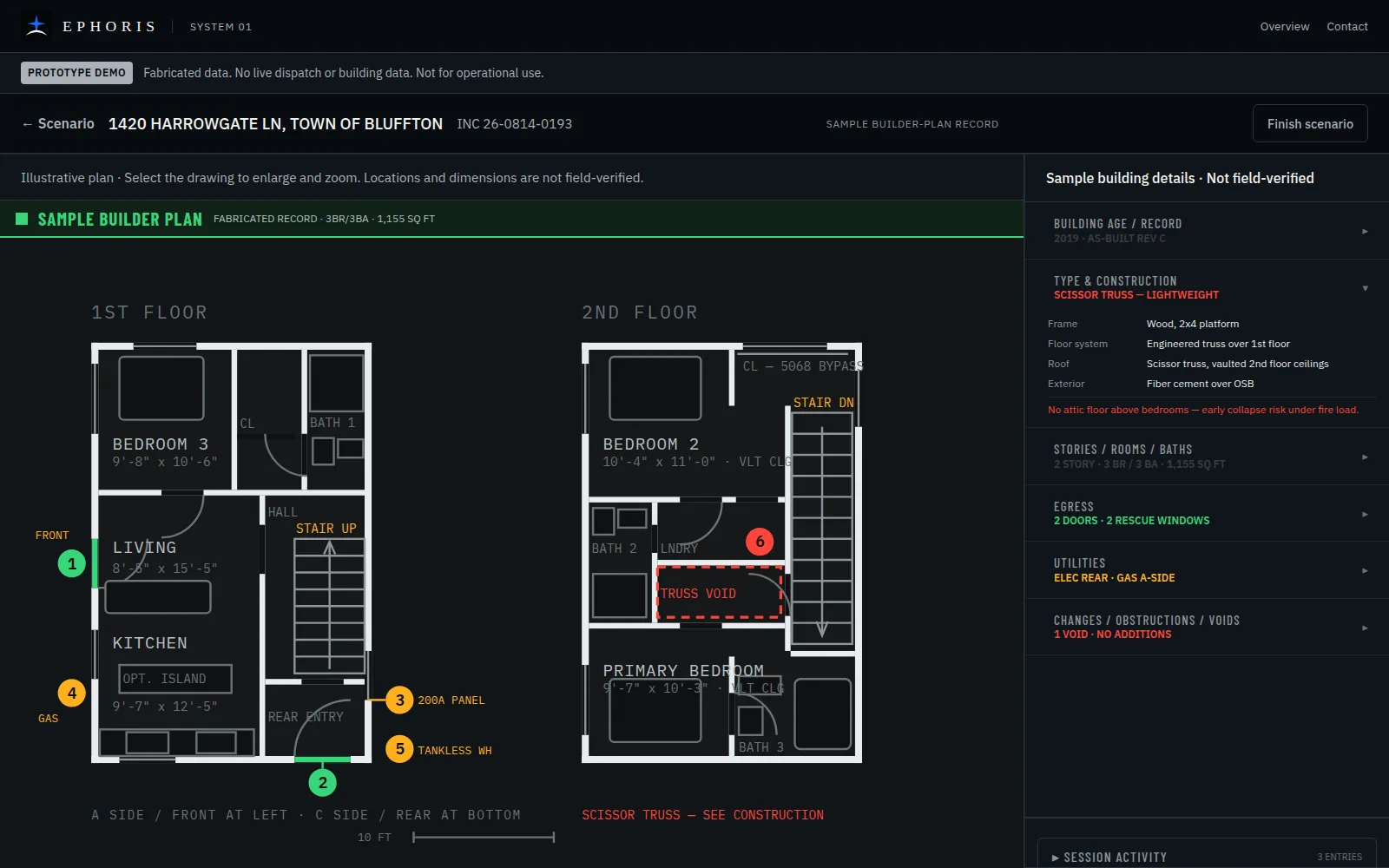
Demonstration prototype
A demonstration of building context alongside a response scenario. A basis for discussion, not an operational tool.
View the prototype03About Ephoris
Ephoris is an early-stage technology company. Our current focus is building intelligence: the information held about structures, and its potential value to the people who respond to them.
04Partnership
We’re seeking conversations with the organizations that hold building knowledge and those that use it.
Tell us what your organization works on, where information is constrained, and what need you see.
Become a PartnerOpens your email app. Please don’t include sensitive building records.
Record types, ownership, revision practices, and conditions for use.
Permitting and property systems, data custodians, and local requirements.
Data formats, potential interfaces, and where building context fits existing software.
Useful information at arrival, field conditions, and evaluation needs.